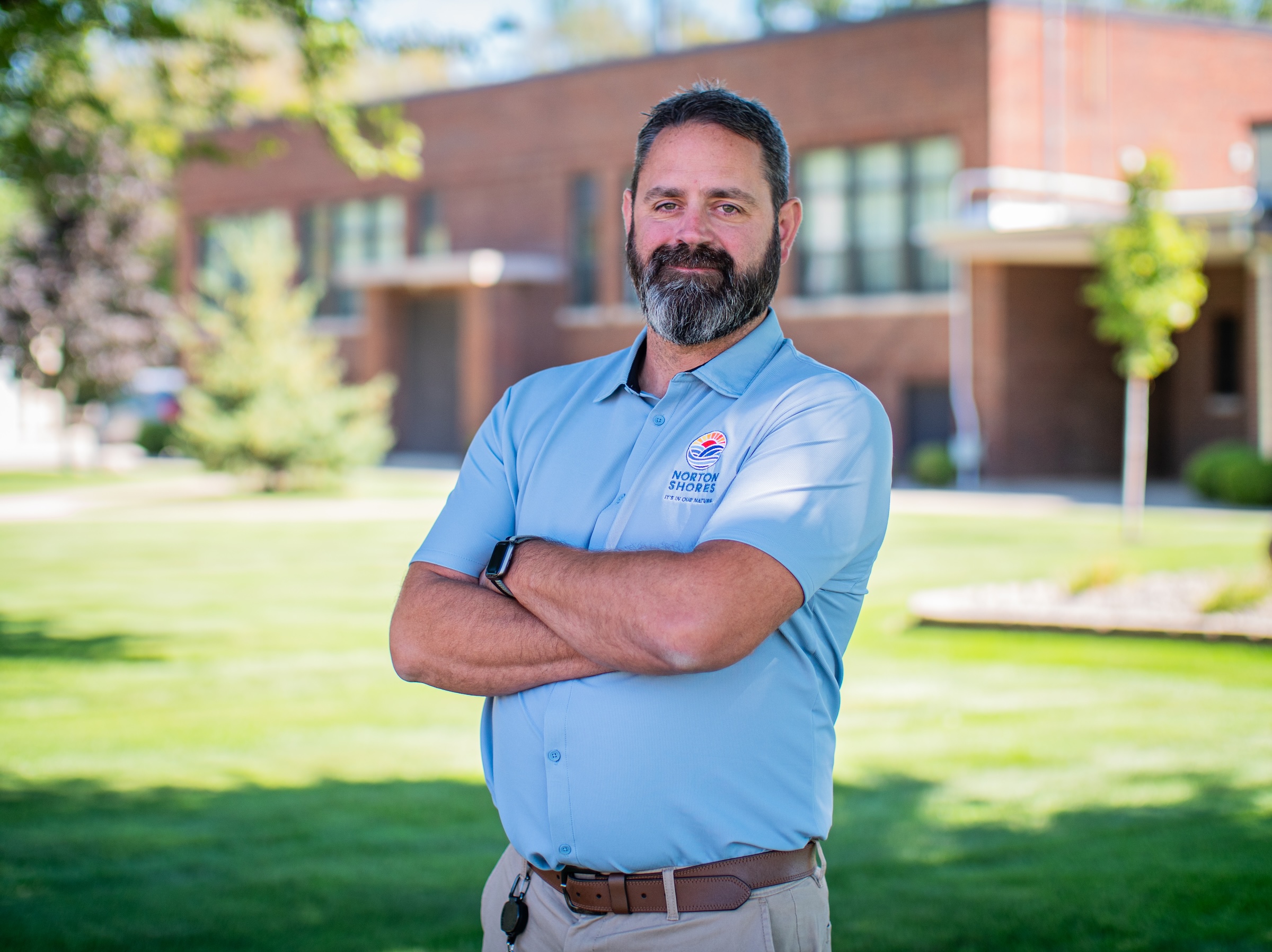
When most people picture police work, they picture the response. A 911 call, lights in the rearview mirror, a report getting written up. Scott VanWylen has done plenty of that in his 12 and a half years with the Norton Shores Police Department.
Ask him about the moment that reminds him why the work matters, and he goes straight to a kindergarten classroom.
“I don’t think I’ll ever get sick of walking into a school building and having 10 or 20 kids all running up and giving us hugs and high fives,” he said. “Something that happens frequently is when we’re doing our lockdown drills. The lower elementary schools always take longer, because every kindergartener wants to give you a hug before you walk out of their classroom.”
VanWylen is the sergeant who oversees the department’s POINT division, and in early September, he will be promoted to lieutenant, taking on both POINT and the detective bureau.
Coming to Norton Shores
VanWylen grew up in Hudsonville and earned his bachelor’s degree at Dordt University in Iowa. When school wrapped up, he headed back to West Michigan looking for work, went through the Grand Valley State University Police Academy, and landed in Norton Shores.
“It’s been a huge blessing to be here and working for this city,” he said. “Great city to work for. Love the people I work with.”
A Career Spent Learning the Whole Department
He started where most officers start, working the road on night shift, before eventually being promoted to corporal. From there, he spent time as a school resource officer covering the Mona Shores elementary schools and Western Michigan Christian. After making sergeant, he went back on the road for a stretch. Now, he is back with POINT.
Along the way, he picked up a long list of responsibilities that residents rarely see. He is one of the department’s lead firearms instructors, a use of force instructor, and a less lethal chemical munitions instructor. He also serves as team commander for the countywide SWAT team, a 19-person unit pulled from agencies across Muskegon County.
The upcoming promotion adds the detective bureau to his plate, which is new ground for him.
“I don’t have a ton of detective experience, but I’m really looking forward to getting my feet wet in there,” he said. “I’m excited for the change, excited for the challenges.”
What POINT Actually Does
POINT stands for Problem-Oriented Intelligence-Led Neighborhood Team. It is the department’s community-focused unit, and its work shifts with the calendar.
During the school year, most of it centers on schools. POINT staffs a full-time school resource officer (SRO) at Mona Shores High School and another at the middle school, assigns an officer as a resource for the district’s four elementary schools, and provides an officer to Western Michigan Christian.
Summer brings a different question, one VanWylen says he gets asked often.
“Everybody always asks us what we do during the summer when school’s not in session,” he said. The answer is that the team gets out into neighborhoods, frequently with a popsicle trailer in tow.
“We drive through different communities and try to connect with local residents, try to build and establish that relationship with the community that we serve, because that’s ultimately what our goal is. To be a resource for the community and serve them the best that we can.”
Officers in the Schools
The high school and middle school SROs are stationed at the buildings full time, with their own offices. They are not spending much of the day at the police department.
Security is part of it. Relationships are the bigger part.
“They’re there really to build relationships with the students, be another resource for them that they can reach out to if they need help or have questions,” VanWylen said. “They really try and fit in well and be part of the staff at their respective schools.”
That means connecting at lunch and recess, and it means working alongside school staff on lockdown drills, fire drills, and severe weather drills.
“Anytime we can be of assistance to the schools, we’re going to be there and help them out,” he said. “The whole goal is to just build that relationship with the students and be a positive role model they can look up to.”
Keeping all of it moving takes a small team covering a lot of ground, from Neighborhood Watch and crime prevention to evidence collection and investigations.
“There’s a lot of stuff that we are tasked with. We get pulled in a lot of different directions,” VanWylen said. “But really, I have a great team around me. I wouldn’t trade them for anybody else. They’re always willing to help out, jump in, get their hands dirty, regardless of what the task is.”
Neighborhood Watch, Updated
A lot of residents remember the Neighborhood Watch signs posted along their street growing up. Those signs are less common now, and VanWylen says the way neighbors look out for each other has moved into group chats and neighborhood pages.
The advice underneath it has not changed.
“Go out and meet your neighbors,” he said. “Know who’s living in your neighborhood. Be friendly. Connect with them, because they’re going to be your greatest resource for stuff going on inside of your neighborhood. And then we’re always there on the back end to come help out if there’s certain needs.”
When residents flag a specific concern, whether that is suspicious activity or a stretch of road where cars are moving too fast, POINT can step in with focused attention on that neighborhood.
Trying to Get Ahead of the Call
VanWylen is straightforward about the balance of the job. A big portion of it is reacting when people need help.
“But the other portion is we’re trying to be predictive and put ourselves in advantageous spots, to be there quicker, to catch stuff sooner,” he said.
Speeding complaints are one of the most common things residents bring to him, and one of the clearest examples of that approach. His team runs targeted enforcement in problem areas and deploys speed signs and speed trailers to show drivers what they are actually doing.
As for what to do if you are the one getting pulled over, his answer is simple.
“Be honest, be polite, be courteous,” he said. “We’re not looking to hammer everybody. We’re out there just trying to make sure the community is safe, and part of our job is to make sure people drive the speed limit. There’s not a single person out there who probably hasn’t sped in their life. We understand that.”
Learning From 40 Other Agencies
This summer, VanWylen finished the School of Police Staff and Command at Eastern Michigan University, a six-month program built for law enforcement leaders. It put him in a classroom with 40 peers from other departments.
“I was able to spend a lot of time with them, talk through our issues, our concerns, our successes, and really learn how other agencies are doing it,” he said. “Steal from them what works for them and try it here.”
He sees it paying off in two directions.
“It’s really going to benefit me going forward, so I can be a better leader for the officers here, but also a better resource for the citizens of Norton Shores.”
The Side You Don’t Picture
For all his training certifications and command roles, VanWylen says the part of the job that matters most is the one nobody pictures when they imagine police work: being a steady, familiar face for kids who might need one.
“It’s not something that you traditionally think of with law enforcement,” he said. “When you think, I’m going to be a cop, that’s not necessarily the side that you think of. But it’s a very important side that we have to be aware of, and we really get to enjoy connecting with those young kids and being a positive role model, because you have no idea what they have going on in their life. If I can be a constant, friendly, smiling face to them, that’s something that’ll never get old.”
Twelve and a half years in, with a new title and a bigger division coming in September, that is still the measure he uses.
“That’s just something that you can’t replace,” he said.